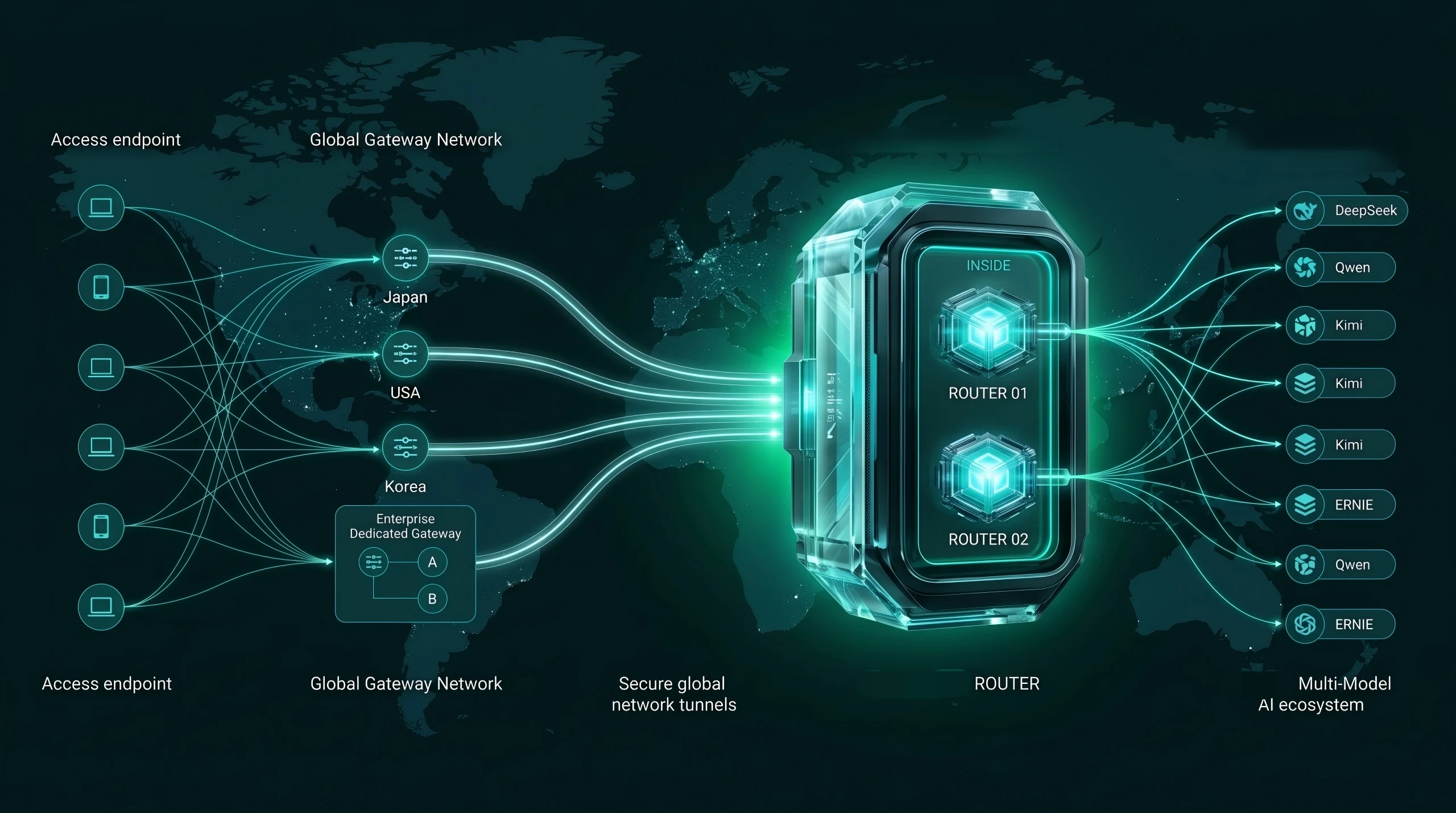
01
Multi-Provider Aggregation
Connect to multiple providers through a single interface, with flexible expansion of model channels.
OpenAIAnthropicGoogleDeepSeekQwen+
One Unified API.
SmartRouter
One API, One Key, unified access to the world's leading AI models.
SmartRouter provides enterprises and developers with a unified LLM API access layer. Through multi-provider aggregation, intelligent routing, automatic failover, and cost optimization, it makes AI applications more stable, flexible, and cost-efficient.
curl https://api.smartrouter.vip/v1/chat/completions \
  -H "Authorization: Bearer $SMART_ROUTER_API_KEY" \
  -H "Content-Type: application/json" \
-d '{ "model": "smartrouter/auto", "messages": [ { "role": "user", "content": "Hello" } ] }'smartrouter/auto
WHY SmartRouter?
Connect to multiple providers through a single interface, with flexible expansion of model channels.
Monitor multiple channels in real time. When one channel fails or slows down, automatically switch before the first byte is sent.
Expose real-time success-rate and latency data, while supporting hard spending limits so AI costs remain clear and controllable.
Simply change the base_url; no application-code changes are required, enabling rapid integration.
CORE ARCHITECTURE
AI GOVERNANCE LAYER
Enterprise Governance for Every AI Request
Secure access, enforce policies, observe every request, and control AI resources through a unified governance layer.
GOVERNANCE CONTROL CENTER
A reserved control surface for the request, policy, resource, and audit signals that govern every AI action.
The selected model receives this request.
Recorded by SmartRouter
REQ-7401REQ-6302REQ-5103Control who can access AI resources across teams, projects, and users.
Turn enterprise rules into enforceable AI access policies.
Designed policy architecture can evaluate access, model, quota, budget, and usage rules before a request reaches the router.
Understand what happened to every request across your AI infrastructure.
Can every AI action be traced?
A request-level record is the architectural basis for traceability. The current RouterGo usage record confirms model, provider, token, cost, latency, status, and timestamp fields after a routed request.
DESIGNED CAPABILITYHow are AI resources being consumed?
See usage by department, project, user, and model.
Connect token, usage, and cost records to accountable owners.
Coordinate resource scheduling across accountable teams and projects.
Detect abnormal AI usage and notify administrators when governance signals need attention.
Illustrative alert categories. No live alerts are represented on this marketing page.
INTELLIGENT ROUTING
Choose the right model path based on real-time performance, availability, cost, region, and routing policies.
SmartRouter continuously evaluates available model channels and dynamically routes each request to the most suitable path — without requiring application-level routing logic.
MODEL PROVIDERS
SIMULATED ROUTING DATAAUTOMATIC FAILOVER
Automatically detect model failures and reroute traffic to healthy AI models in real time.
LIVE ROUTING DECISION
Continuous request path
Automatically reroute traffic when the primary model becomes unavailable.
Restore traffic automatically when the model recovers.
Prevent individual model failures from affecting the entire AI service.
Continuously monitor model health, latency and request status.
AI COST INTELLIGENCE
$11,260SAVED
With SmartRouter intelligent routing
MODEL MARKETPLACE
Explore leading AI models across language, vision, image, video and multimodal workloads — unified through SmartRouter.
One intelligent access layer evaluates capability, task fit, cost and live status behind a single API.
DEVELOPER INTEGRATION
Connect once to SmartRouter and access multiple LLM providers through one unified API gateway.
Keep your existing integration workflow while SmartRouter handles model routing, failover, and provider switching behind the gateway.
Use one SmartRouter key across your model integrations.
https://api.smartrouter.vip/v1
SMARTR_ROUTER_API_KEY
from openai import OpenAI
import os

client = OpenAI(
    base_url="https://api.smartrouter.vip/v1",
    api_key=os.environ["SMARTR_ROUTER_API_KEY"],
)

response = client.chat.completions.create(
    model="deepseek-chat",
    messages=[{"role": "user", "content": "Hello SmartRouter"}],
)

print(response.choices[0].message.content)
UI demo only. No request is sent.
POSTmodel: deepseek-chat
messages: [...]200 OKmodel: deepseek-chat
usage: 2,130 tokens · 96msAll request, response, latency, and token values on this screen are simulated UI data.
// Request details will appear here.
// Key routing details will appear here.
Build the request your client will send, then inspect the raw response.
// The response will appear here.
Public model IDs stay stable while deployment names remain configurable.
Sign in to see the API tokens and requests associated with your account.
| Time | Route | Provider | Input | Output | Cost | Latency | Status |
|---|
Your account owns browser requests and requests made with your personal RouterGo API key.
Create accounts, review lifetime API token totals, and suspend access when needed.
| User | Role | API key | Requests | Tokens | Cost | Status | Manage | Detail |
|---|
Search and manage files uploaded through the workspace.
Manage storage endpoints and their routing priority.
| Name | Address | Download URL | Username | Priority | Selection rule | Password | Actions |
|---|
| Name | Size | Uploaded | Uploader | Actions |
|---|
Inspect one user's token and cost profile with account-style analytics.
Audit account credits, and apply signed admin adjustments to any user balance.
| User | Amount | Payment reference | Submitted | Status | Reviewed |
|---|
Rates apply per one million tokens. Changes affect future completed requests; existing usage keeps its recorded cost.
| Purchase keys | Model | Input / 1M | Output / 1M | Cached input / 1M | Purchase rates / 1M | Earn | State | Notes |
|---|
Configure server-side delivery and the bilingual messages used by authentication flows.
RouterGo accepts the Chat Completions contract at a single local endpoint.
/v1/chat/completionsLoading model catalog...Set provider keys as environment variables. Browser traffic never receives those keys.
Sign in, then open Account to rotate a key that attributes API usage to you.
Open Provider key to use a session-only upstream credential in the browser.
The browser and the external API share the same routing layer.
Provide each provider key in the server environment. Set its matching *_MODEL variable when the account uses a different deployment name.
Your application sends one of the four public IDs. RouterGo maps it to the configured upstream model before forwarding the request.
Sign in and open Usage to view API requests, token totals, and recorded costs. The aggregate is kept with your account.
Set stream: true and RouterGo forwards the upstream server-sent event stream without buffering it.
One account for browser chat, API access, and usage tracking across your workspace.